· earth · 2 min read
The Brutal Math of the Mariana Trench: Why Water Can Crush Steel but Spare Flesh
At 11,000 meters beneath the surface, hydrostatic pressure reaches 1,100 atmospheres. How physics destroys engineered metal hulls while abyssal life thrives.
The Pressure Equation
In intermediate science classes, hydrostatic pressure is introduced as a clean, straightforward linear formula:
P = ρ · g · h
Where P is hydrostatic pressure, ρ (rho) is fluid density, g is gravitational acceleration, and h is fluid depth. On a whiteboard, calculating the pressure of an Olympic swimming pool yields tidy numbers.
Take that same formula down to the Challenger Deep—the deepest known crevice on Earth, sinking nearly 11,000 meters into the Western Pacific—and the numbers become terrifying.
The Physics of an Oceanic Forge
At the floor of the Mariana Trench, the water column overhead creates a hydrostatic force exceeding 1,100 times standard atmospheric pressure. That is roughly 1.1 metric tons pushing inward against every single square centimeter of surface area.
To visualize this: it is equivalent to supporting an adult African elephant balanced on the surface of a human postage stamp.
If a conventional steel submarine hull suffers a hairline fracture at this depth, it does not slowly leak. The water acts as an explosive hydraulic cutter. The differential pressure between the exterior sea and the atmospheric interior forces a cataclysmic implosion: the entire vessel collapses inward within 20 to 30 milliseconds—faster than human nerve endings can register pain.
The Biological Loophole
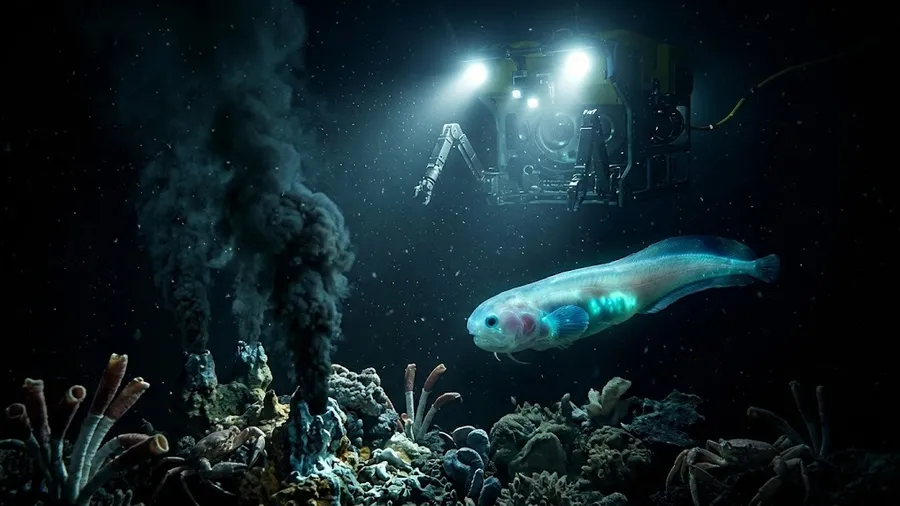
Yet, swimming through this violent forge are delicate, pale, gelatinous organisms: Pseudoliparis swirei, the Mariana snailfish.
Why does an elephant-weight column of water shatter reinforced titanium, while leaving a soft, boneless fish intact?
The answer lies in molecular chemistry and fluid compressibility:
- No Air Cavities: Metal submarines collapse because they enclose low-density gases (air). Snailfish have zero air bladders or gaseous voids. Their bodies are made entirely of non-compressible liquids and water-saturated lipids. When external pressure rises, internal fluid pressure equalizes instantaneously.
- The Molecular Stabilizer (TMAO): Under extreme pressure, water molecules are squeezed into tighter tetrahedral geometries that warp and denature ordinary biological proteins. Deep-sea fauna survive by synthesizing high concentrations of trimethylamine N-oxide (TMAO)—a specialized chaperone molecule that binds water around cell proteins, acting as an internal molecular scaffold.
Man-made machines fight against the pressure equation and risk destruction. The abyss’s native inhabitants survive simply by becoming an extension of the fluid itself.