· cosmos · 2 min read
The 400-Year-Old Geometry Law Quietly Keeping Starlink From Falling From the Sky
In 1619, Johannes Kepler calculated planetary motion using quills and candlelight. Today, his third law governs thousands of commercial satellites orbiting Earth.
The Blackboard Memory
In high school physics, few equations feel more abstract than Johannes Kepler’s Third Law of Planetary Motion:
T² ∝ a³
Teachers wrote it down, asked students to calculate the orbital period of Mars, and moved on. To most teenagers, it seemed like an obsolete piece of 17th-century trivia—a geometric exercise solved by a German astronomer long before the invention of electric lights, internal combustion engines, or digital computing.
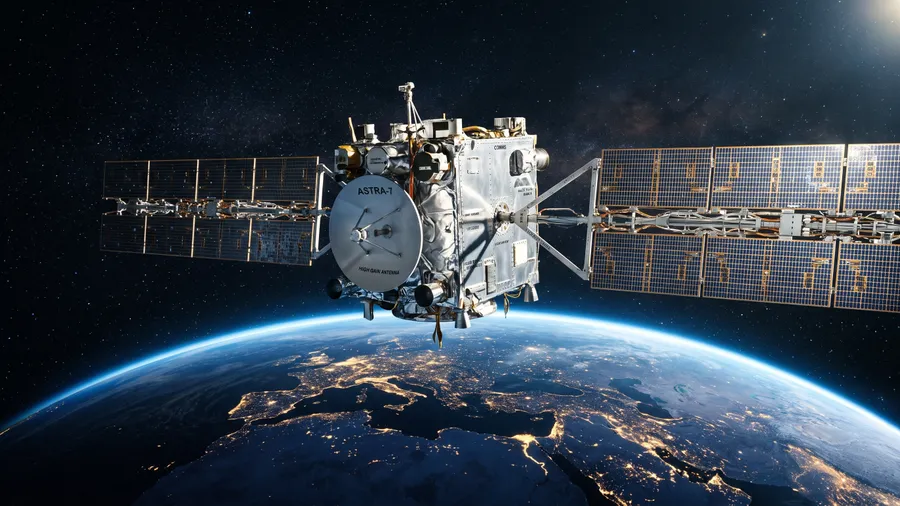
Yet right now, more than 10,000 active artificial satellites are racing above your head. Every single one of them—from SpaceX’s Starlink constellation to geostationary weather monitors—survives solely because of this exact mathematical relationship.
The Hidden Mechanics: Balance at 17,500 mph
Kepler discovered that the square of an orbital period (T) is directly proportional to the cube of the semi-major axis (a) of its orbit. Translated into modern engineering terms: the closer an object is to Earth, the faster it must move to avoid being dragged into an incinerating death spiral.
In Low Earth Orbit (LEO), around 550 kilometers above sea level, Earth’s gravitational pull is still roughly 90% of what you feel on the surface. Satellites do not float in “zero gravity”—they are in permanent free-fall.
To keep from hitting the curvature of the planet, a satellite must fly sideways at approximately 27,000 kilometers per hour (7.5 km/s). At this altitude, it completes a full lap around our planet every 90 minutes.
Move outward to 35,786 kilometers, however, and the geometry changes dramatically. At this precise altitude—the Clarke Orbit—Kepler’s formula dictates an orbital speed where one revolution takes exactly 23 hours, 56 minutes, and 4 seconds.
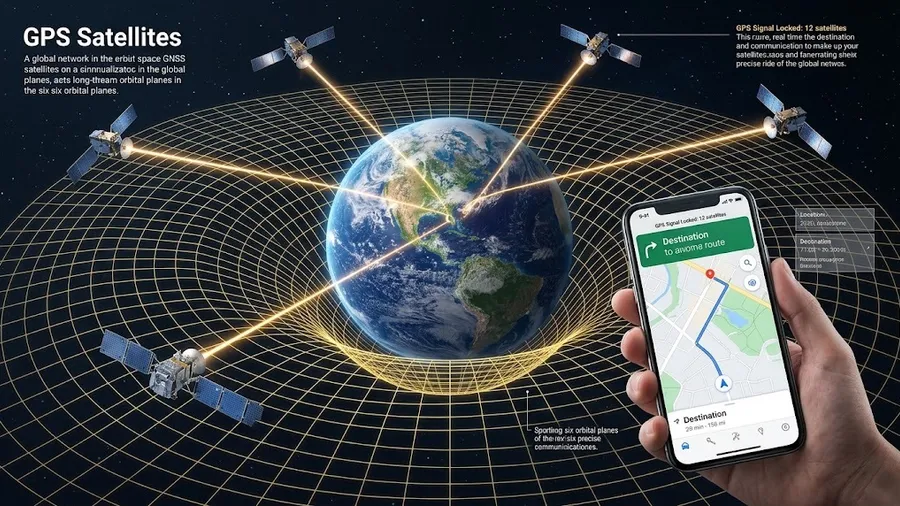
Because this matches Earth’s axial rotation perfectly, telecommunication satellites appear frozen over a single point on the equator. Without Kepler’s law calculated down to microsecond tolerances, satellite TV, intercontinental financial time-stamps, and oceanic GPS would instantly fail.
The Invisible Engine Above Us
Next time you watch a live broadcast from the other side of the planet or connect to satellite internet in the middle of the Atlantic, you are relying directly on mathematics drafted by candlelight four centuries ago. Kepler was not solving a textbook homework problem; he was discovering the operating system of the cosmos.