· future · 3 min read
The Tyranny of the Rocket Equation: The Brutal Law of Physics Trapping Humanity on Earth
Why is human spaceflight so agonizingly expensive and difficult? Konstantin Tsiolkovsky’s 1903 formula proves why 90% of every spacecraft is nothing more than fuel.
The Exponential Trap
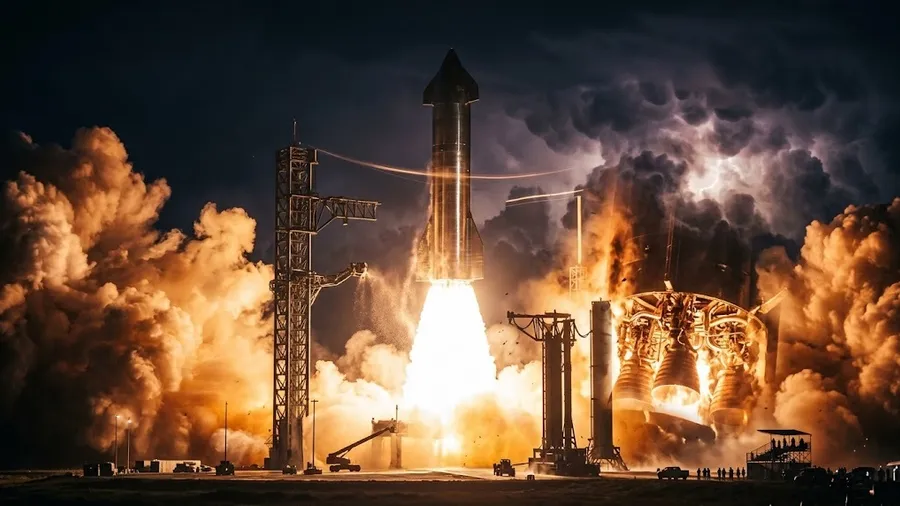
In science fiction films, starships take off from surface runways like luxury jetliners, burn their thrusters effortlessly across interplanetary distances, and land safely on distant worlds.
Real aerospace engineers refer to this daydream with grim humor, all because of an unrelenting mathematical equation published in 1903 by self-taught Russian physicist Konstantin Tsiolkovsky:
Δv = vₑ · ln(m₀ / m_f)
This is the Ideal Rocket Equation. It is arguably the single most unforgiving mathematical reality in engineering, describing what NASA scientists historically termed “The Tyranny of the Rocket Equation.”
The Mathematical Curse of Propellant
To escape Earth’s gravitational well and achieve Low Earth Orbit, a vehicle must reach a velocity change (Δv) of roughly 9.4 kilometers per second.
The fundamental problem is this: to accelerate mass forward, a chemical rocket must shoot burning exhaust gases backward. But that fuel has mass.
- To lift the payload, you need propellant.
- To lift the propellant needed to lift the payload, you must add more propellant.
- To lift that extra propellant, you must add even more propellant.
Because of the natural logarithm (ln) in Tsiolkovsky’s equation, fuel requirements scale exponentially, not linearly.
Consider the gargantuan Saturn V rocket that carried Apollo 11 to the moon:
- Total launch mass: 2,970,000 kilograms (2,970 metric tons).
- Mass of the actual payload returning to Earth: A mere 5,500 kilograms.
- More than 92% of the entire skyscraper-sized rocket was pure propellant (liquid oxygen, RP-1 kerosene, and liquid hydrogen).
The actual useful spacecraft sitting on top was merely a tiny tin can balanced on a massive explosive bomb designed simply to accelerate its own fuel.
Breaking the Iron Law
This equation explains why chemical rocketry will never support routine interplanetary exploration. We have already pushed liquid oxygen, liquid hydrogen, and liquid methane combustion close to their theoretical maximum exhaust velocities (vₑ).
Inverting Tsiolkovsky’s equation reveals the true physical barrier:
m₀ / m_f = e^(Δv / vₑ)
Every linear increase in required velocity demands an exponential surge in launch mass. To bypass this iron law, future mission architectures must stop dragging all their propellant out of Earth’s primary gravity well:
- Orbital Propellant Depots: Launching deep-space exploration vehicles with dry tanks and refueling them in Low Earth Orbit using reusable automated tankers.
- Nuclear Thermal Propulsion (NTP): Using compact fission reactors to superheat light liquid hydrogen, effectively doubling exhaust velocity and slashing necessary propellant mass.
- Non-Rocket Space Launch: Bypassing atmospheric chemical burns entirely through orbital rings, skyhooks, or kinetic mass-drivers.
Every mission humanity launches into deep space is an active, desperate war waged against a simple natural logarithm.